

 Enterprise monitoring solutions have heterogeneous roots across hybrid cloud environments and beyond the virtual layers into the deep infrastructure of data centers around the world. In such a complex and ever-changing environment, IT organizations are challenged to understand what the environment looks like and how its inner workings relate. At this point, the need for a real-time IT infrastructure model is crucial in managing digitized organizations as they scale, and users of these solutions must fully understand what “the model” provides. Characterizing an IT infrastructure model often proves to be a challenge, so we’ve provided a few definitions to help seed the conversation:
(1) Intrinsic metadata that ties services and components across physical and virtual infrastructure in the form of a graph data structure.
Consensus: It’s not on par with comprehending quantum mechanics, but trying to conceptualize isn’t trivial.
(2) A real-time representation of the physical and logical topology within and across data centers.
Consensus: Well, it’s accurate but not exactly party conversation.
(3) Description of how pieces of IT infrastructure exist and how the parts within those pieces are interconnected.
Consensus: It’s better, but golly-gee, this isn’t easy.
(4) How about a picture…
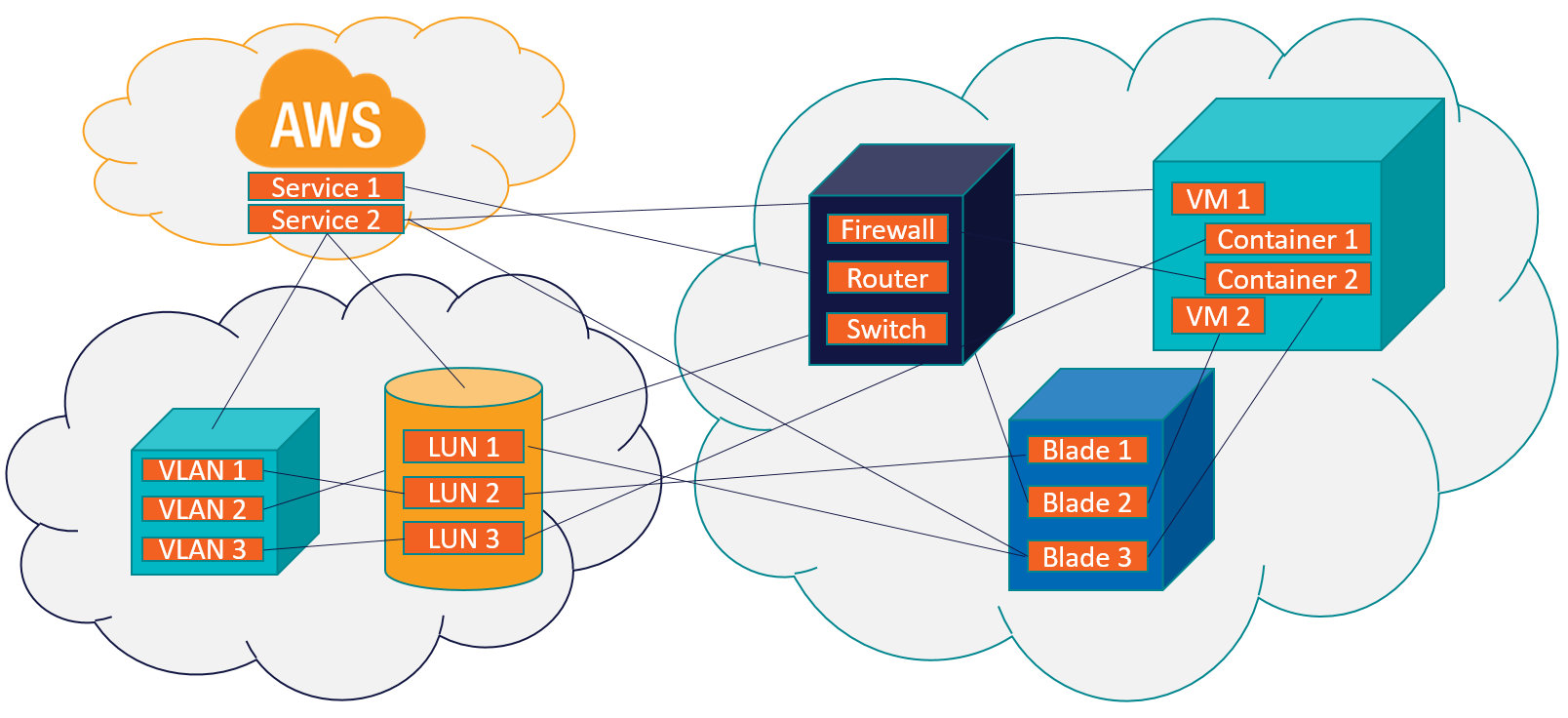
Even this relatively simple model is surprisingly complex — and since most enterprise data centers deploy tens to hundreds of thousands of devices across data centers along with the inclusion of tens of millions of devices via the internet of things (IoT), it’s easy to see the difficulty in creating such a topology. In addition, with the advent of virtualization across storage, network and compute, the model is constantly in flux as new components are created, moved or removed with policy-based orchestration mechanisms — either internal or external to the devices themselves. Considering the ephemeral microservices, which often exist in the form of containers in other layers, the intricacy is beyond human capacity to process. In fact, many have noted that dealing with the changing relationships in an IT infrastructure model is akin to neural networks, which means your data center admins are, effectively, brain surgeons.
Today’s enterprise monitoring solutions must have the ability to interrogate the IT environment to discover, create and maintain an IT infrastructure model in real time. Understanding the contents of a model will drive better IT decisions, and correlating the model information to the performance metrics, events, etc. is key in establishing proactive actions and determining root cause when problems occur. In upcoming posts, we'll discuss how Zenoss deals with IT infrastructure models and why they're important in an organization’s overall IT operations management (ITOM) solution.